Lost in the shadow of Pompeii popularity is Herculaneum. Everyone has studied the history of Mt. Vesuvius and its aftermath the most famous being Pompeii but there are other areas that were affected and ruins found over the years. There are actually five archeological sites to visit – Pompeii, Herculaneum, Oplontis, Boscoreale and Stabiae. I’d never heard of others either! Having visited Pompeii twice already, I opted to explore Herculaneum and see how it differed from it’s more famous neighbor. Herculaneum is an easy day trip from Naples and Sorrento.
Train to Herculaneum (Naples to Ercolano Scavi)
You can read my adventure on the Circumvesuviana train from Naples to Herculaneum but the key takeaways are – don’t get distracted, board the blue or green line, have cash for the ticket and bathrooms and since there are two Ercolano stops you want the Ercolano Scavi stop. The ride should be less than ½ hour from Naples Garibaldi Train Station.
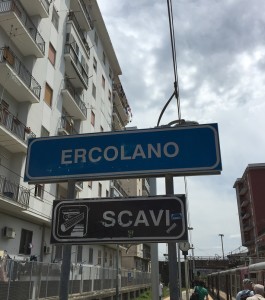
Ercolano Scavi
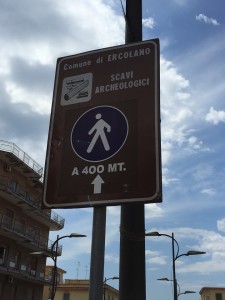
The train station is at the top of the town and looks and feels like any suburban train station which is to say it’s unremarkable except for the folks who greet you when you exit. Do you want a taxi? Do you want to buy x? Nope. You can walk straight downhill (remember there’s an uphill on the way back so break it up with a lunch or dinner stop) on either sidewalk to the Herculaneum entrance, about ¼ mile.
First Look – The City of Herculaneum
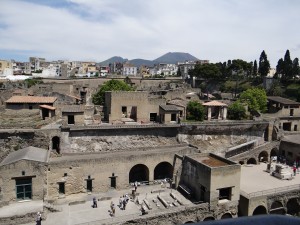
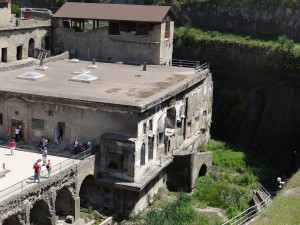
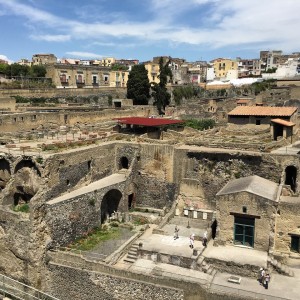
As you enter the grounds at Herculaneum your first view is this and I was really surprised to see how well preserved the buildings looked from above.
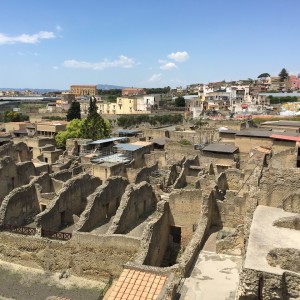
The city, at the base of the mountain, was devastated and yet so well preserved as you can see from above. Much was due to the fact that Herculaneum was a rich sea town and it was covered with wet ground and tsunami like effects along with the hot ash and apparently the wood used carbonized the structures. This difference has led to many discoveries over the years that are much different from Pompeii (wood furniture, a boat and everyday objects). Much is still undiscovered. To enter the ruins and explore further, you need to go to the Visitor Center for a ticket. Combination tickets are available if you wish to spend three days here or at any of the other locations in the area.
Herculaneum Visitor Center
The visitor center is all shiny and new. The entry price was €11. Backpacks are not allowed so you will need to check your pack at the center. The center has free guides in various languages (you can also download the guide free to read in advance). There are bathrooms (free!) at the center and near the snack bar (I had to laugh at the sign since bathrooms in Italy generally charge a fee).
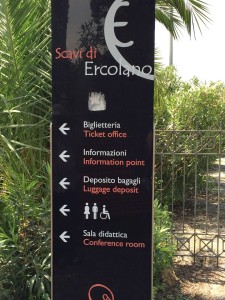
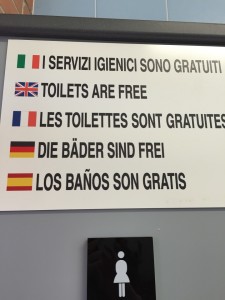
As you exit the visitor center you walk the path to the top of the railing and look down at this unbelievable town that existed so long again. The juxtaposition with the newer homes and apartment buildings surrounding the excavation was crazy. You can see how deep down the town was vs. today’s level and you wonder what else is underground waiting to be discovered (In Naples, the underground tour was one such find and even then there is more to discover underneath). It’s hard to believe that this was a sea town given the land that surrounds it now.
The Roman Homes of Herculaneum
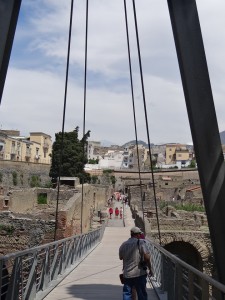
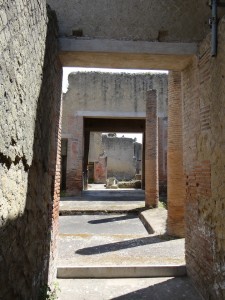
With map in hand, my new friends and I started at the end of the town walking over the bridge to what was a street lined with homes. I noticed the narrow streets and what seemed like sidewalks in some places. There are thirty four buildings open to visitors – Roman homes, public buildings like the Temple and Palestrae, shops and baths.
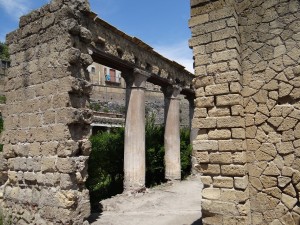
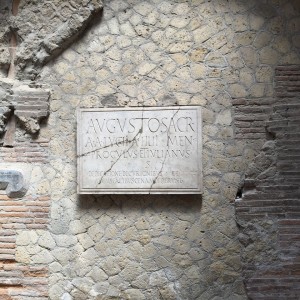
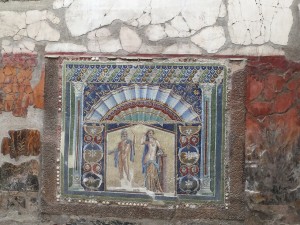
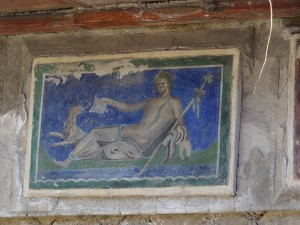
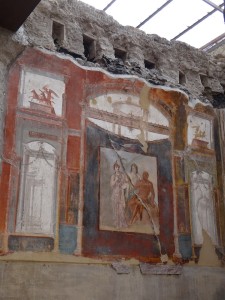
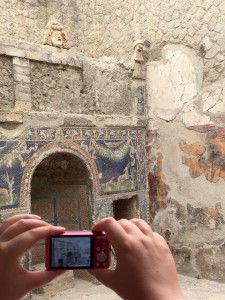
Herculaneum was a wealthier town than Pompeii and I felt that almost immediately in the level of detail, color and condition of the homes – it is amazing. Unlike Pompeii, there are full frescos in many colors, mosaic floors and buildings that were slightly affected. You had a great opportunity to understand scale of the buildings (many vaulted or multi-storied), how they connected, the decorations on the floors and the walls as well as imagine how life existed in this village back in its time.
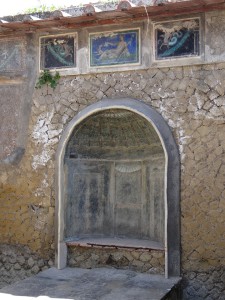
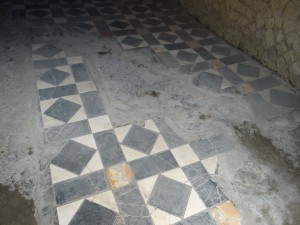
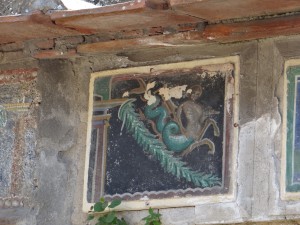
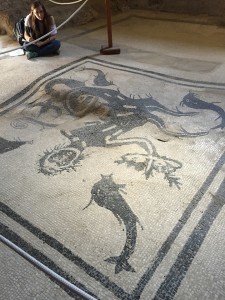
In Pompeii, where many ruins are roped off, here in Herculaneum, we, for the most part, had free reign which meant that we were very curious to see the differences in each of the structures. There were many to see and similar to an open house at home, we were curious to see how the neighbors lived, which meant it took a long time to visit each home. Herculaneum is not a quick visit in my opinion, you have the opportunity to explore a bit more in depth according to your interest. Of course, you can do a drive by for the Instagram photos but to glimpse into history you’ll want to explore the nooks and crannies.
The Skeletons of Herculaneum
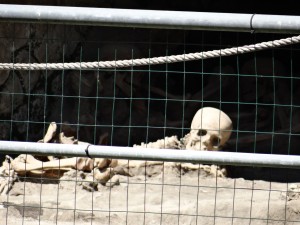
As the excavation has occurred in many stages over the years, initially found in an underground tunnel dig, there are still surprises to be discovered. One recent discovery, in 1980, was 300 skeletons found with coins and other everyday objects at the time as they tried to escape. Seeing the skeletons made this history lesson so much more real. At a time when we’ve seen so many natural disasters and the consequences, this archeological site is a reminder how nature can destroy so many years ago but we can’t forget the present.
The Colors of Herculaneum
That the colors are still able to be seen and appear in some cases vibrant thousands of years later is remarkable. At Pompeii, I’ve seen the red hues and the blues. In Stabiae, at Villa San Marco, many of the better frescos were removed but the reds remained. Here in Herculaneum, full color was on display.
The Village Life of Herculaneum
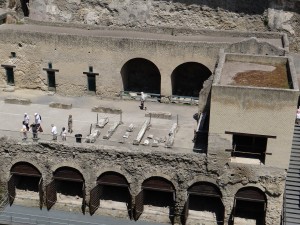
As I walked through the neighborhood of homes, I turned into what seemed to be the town meeting place based on its size and shape. There was large Temple with vaulted ceilings and an altar space as well as what seemed to be stalls for a market or storefront.
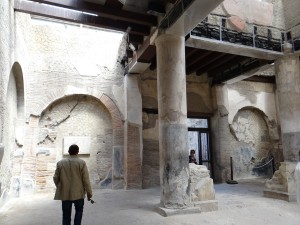
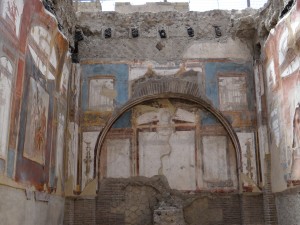
You can imagine the baker was there (we saw the stoves) and start to build in your mind the trading post and shopping available in the town before Mt. Vesuvius surprised the village.
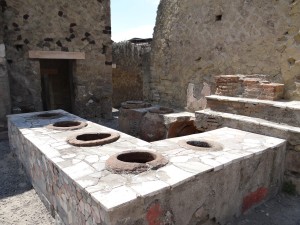
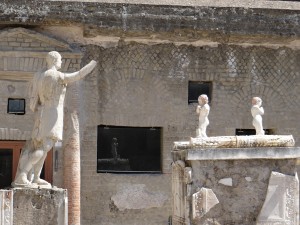
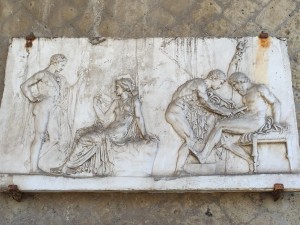
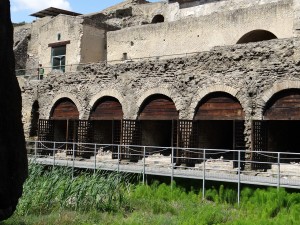
We walked along the street leading downhill toward a water source and what would be seen as boathouses potentially and now the site of the found skeletons. This view of the village was very different from above. Upon first sight above, it was ruins, yet now as I explored further, I was personalizing the town and how it must have felt to wake up on a normal day, go about your lives only to have the unexpected wipe it all out – to cease to exist. Maybe it was the emotional toll of the past month with the unexpected shift in my life or the natural disasters of my lifetime that I’ve watched in the media that made this visit so much more to me.
The Cool Exit of the Tunnel
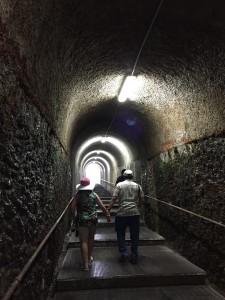
Having started our tour of the town from the bridge up through the town and then down to the water source, we exited walking up the tunnel (passing some who decided this was their starting point). After the sweltering visit in the direct sun for which some homes provided a temporary respite from the sun, this uphill steady walk of steps was very cold and dimly lit. It was as if the cool breeze and uphill climb was transporting me back to life. I was leaving the sad memories of the visit behind and slowly ascending back to the detached history that I began with. It was definitely a different experience than Pompeii.
Herculaneum – Final Thoughts
I chose to slowly visit the site with my new friends – I didn’t run ahead as I normally do. I read the guide with each address, wandered through with few visitors and sat down to take it all in. The fact that the site is a much smaller area and more well preserved compared to Pompeii allowed me to personalize this visit. I may not have learned about Herculaneum in my history books but it should be visited and explored in addition to Pompeii so you can have a compare and contrast like I did. Herculaneum was a highlight on my Naples visit, more than I thought it would be.
]]>
Italy by train can be quite easy for travel between cities (Naples-Rome-Florence-Venice-Milan) as well as local travel to towns and villages along the way if you do a bit of research and don’t get distracted. I was interested in a day trip via train from Naples to Herculaneum, a town affected by Mt. Vesuvius in 79 AD and an UNESCO World Heritage Site. I decided to skip the pricey bus tour and do it myself via the Circumvesuviana train which has five train routes around Vesuvius (each marked by a specific color) and in about 20-30 minutes would transport me from Naples Garibaldi station to Ercolano Scavi in nine stops on two of the five train options. Herculaneum is an easy day tour from Naples if you arrive by cruise ship. I was thrown off my solo traveler game by a few American tourists – there’s a story to tell, a lesson to be learned and a free lunch!
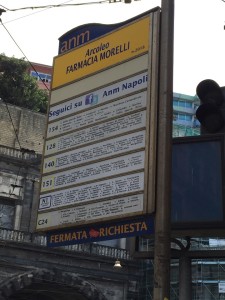
Bus N151 from the Waterfront (or Cruise Terminal) to Naples Train Station
I was staying along the waterfront at Partenope Relais and many local busses were frequently flying around the corner to all parts of the city. Bus N151, would transport me to the Naples Garibaldi Train Station. I want to say the cost was about €1.20 vs. €15 taxi so I decided to experience the local bus. I’m accustomed to standing on the bus so didn’t mind standing with space around me but when we stopped at the ferry/cruise port and folks crammed in with suitcases and I was packed like a sardine did I start to wonder about the ROI on the bus vs. taxi conundrum. Luckily, I’m tall and had the upper window for air as it was a humid morning. With many of the Italians standing or sitting around me eye to boob height, I was a bit uncomfortable so I looked out the window at the local life passing by. With each stop, I hoped people would leave but they didn’t spill out until the last stop at the Naples Garibaldi Train Station.
The Naples Train Station (Naples Garibaldi)
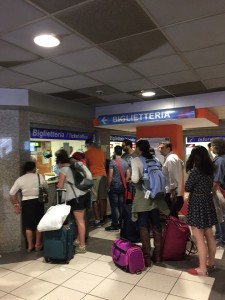
Never one to look lost or wander aimlessly in a foreign train station, I had done a bit of online research and found my way underground (down the stairs from the main floor of Trenitalia and high speed trains) to the local Circumvesuviana ticket windows (look for blue signs that say Biglietteria which is the ticket office). Quickly, I learned what I called the “Italian way”. The “Italian way” involves me picking one of three lines (always the wrong line), waiting until it was my turn and then the man behind the window puts up the “closed” sign as I approach. I, and the others, shifted to the other lines because this is apparently how it works, of course I was grumbling about “inefficiencies of the lines”, “poor customer service”, “fairness”, etc. I was not happy nor was I really surprised as I was learning about daily life in Italy.
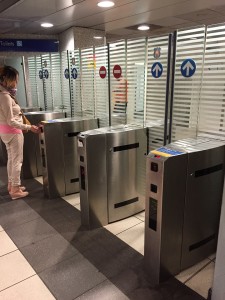
Again I waited and when it was my turn, a guy tried to cut ahead of me and without me speaking any Italian, I said a forceful “no” with a look of indignation mixed with Philly street that said it all as he made his way to the back of the line. The agent didn’t speak English but I had written Herculaneum/Ercolano on a piece of paper to show him (I find this is an easy way to avoid problems) and had cash ready (no credit cards, only cash). With my day ticket in hand, I had the obligatory “pee before you flee” visit to the restroom before making my way to the tracks.
The Bathrooms at the Naples Train Station
Unlike the Amtrak bathrooms in the U.S., which frankly are abysmal/disgusting (our tax dollars not at work), the Italian train station bathrooms are pretty nice and very clean. They should be as you need to pay to pee (budget this line item folks). I’m not keen to pay for a basic need but this is commonplace, good or bad, in Italy.
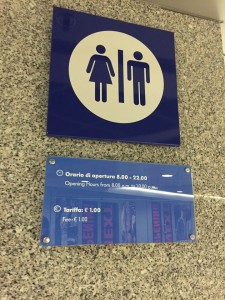
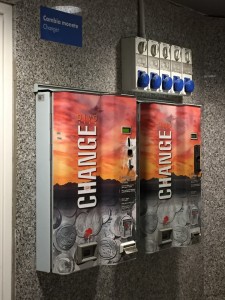
The signs are easily marked to find the bathroom but the signs are missing the €€€. Unlike the other bathrooms with cover charges of 50 euro cents, the Naples train station bathroom charges 1 Euro!! (about $1.15 at the time).
Don’t worry if you just have bills, there is a convenient coin machine to break the bills so you can put the coins in the slots to gain entry to the bathroom.
Circumvesuviana Train from Naples to Herculaneum
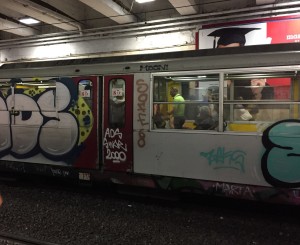
After the gouging at the bathrooms, I made my way to the train track and looked around. You could be anywhere in the world standing at the train platform however, this being Naples, the graffiti covered train cars approached. You might think it was the 70’s or 80’s in NYC with the vision of vandalism but it wasn’t, this was Naples – chaotic and gritty.
The track had three options – Red to Sarno (wrong), Green to Poggiomarino (good for Herculaneum and Pompeii) or Blue to Sorrento (good for Herculaneum). Two of the three trains would stop at Ercolano Scavi (yes, you already know what happened). The trains from Naples to Sorrento are notorious (right or wrong) for pickpockets and thieves as it is filled with tourists with too many bags, easy cash and distracted on their way to the luxe Amalfi Coast via Sorrento. An American couple approached me to ask about the train as they were going to Herculaneum too. Then a few more folks gathered around (funny how I collect clueless Americans).
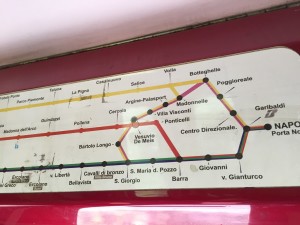
We made a group decision to board the train (I didn’t see the train name or color when it arrived as the couple was talking to me) with everyone else on the platform and almost immediately a young man told us in Italian, “No Sorrento” and we nodded and said “Si” as we weren’t going to Sorrento. He kept at us for many stops (I should have whipped out my TripLingo app to converse with him but he was talking to the couple away from me as I watched the stops along the map) and all of us were skeptical based on what we had heard so just said in English “we aren’t going to Sorrento”. And then the train made a left after Barra and I knew that “No Sorrento” meant I had boarded the Red (wrong) train that wasn’t going to Ercolano Scavi. I was that typical distracted tourist! It’s been awhile since I made a rookie mistake. (Lesson Learned – Americans are distracting! and There’s always another train!)
Time to Go Back to Barra
I told my new American friends that the train diverted and I was getting off at the next stop, Ponticelli, to turn around. They weren’t sure about my plan but I showed them the map and they reluctantly agreed to follow me. So the young Italian “No Sorrento” guy had been right we weren’t going to Sorrento and I think may have had an Italian version of that big knowing smile that says “I told you so in Italian” as we left the train.
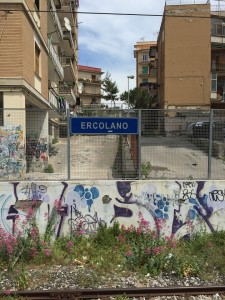
As it was Sunday, the trains weren’t running on a normal weekly schedule so we crossed the tracks to the other side surrounded by trees and homes in the background waiting for the next train. The upside was that we got to talk about our travels for the half hour or so. One couple was going to Herculaneum like me, the other two couples were going to Pompeii. We were all in various stages of travel – beginning, middle, and end with different ways to traverse Italy but all with great food and wine memories thus far.
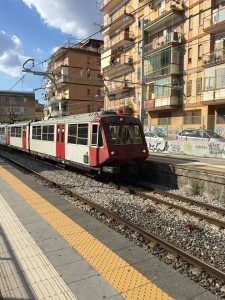
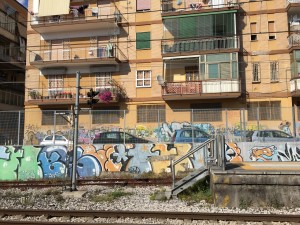
Going back one stop to Barra, we switched to the other side of the platform to resume our journey toward Ercolano Scavi (Pompeii and Sorrento). My view was of more graffiti on the walls that bordered the train tracks with apartment buildings in the background filled with laundry drying on lines in the sun (I’m not sure what Europe has against clothes dryers).
Ercolano Scavi Train Station
The stop at Ercolano Scavi is unremarkable as it would be in most suburbs but there are two Ercolano stops so make sure you get off at the Ercolano Scavi for Herculaneum. The difference was that we were asked if we needed a taxi to Herculaneum, a quick ten minute walk downhill.
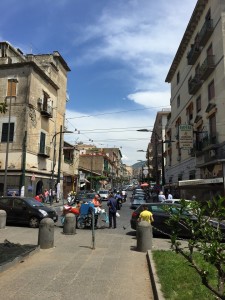
Unless you have mobility issues, the downhill walk (about 1/4 of a mile at 400m) is easy so bypass the taxi line. We passed the normal market shops, cafes, bars and restaurants as you would expect near a train station. The sun was bright and beating strong as we approached the ruins (thankfully I had bottled water and a power bar). My new friends asked me to join them to discover the ruins and later for a late lunch (upside to solo travel is being adopted for the day).
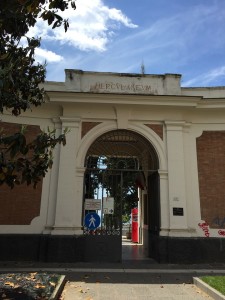
So how will Herculaneum measure up to Pompeii?
]]>
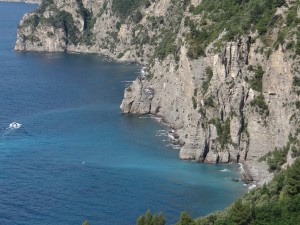
My first visit to the Amalfi Coast was more than twenty years ago on a bus tour of senior citizens where I was their token granddaughter. It was a busy bus tour of Italy over ten days with Globus Tours. We were scheduled to stay overnight in Sorrento but the hotel was full so we were moved to Le Agravi, a luxury hotel with amazing apricot croissants and a view that made me imagine my future wedding (little did I know) along the Amalfi Drive in Positano. The windy roads along the Amalfi Drive felt scary (I didn’t see guardrails from my bus window, just a very steep drop below to the water). We had a woman in her late 50’s at the time (a young one on this tour) who was afraid of heights and all of the twists and turns of the road coupled with the views made her scream in fear for the entire ride. This was my first encounter with the Amalfi Coast and the famed Amalfi Drive. Quite memorable.
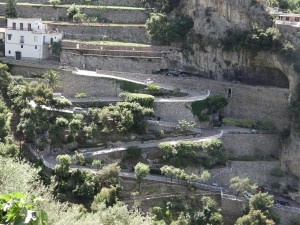
The Amalfi Coast Tour with Marcello of See Sorrento
Many years later I would revisit the Amalfi Coast on a day tour from Naples, the cruise stop, with new friends from the repositioning cruise. I met Marco and Marcello that late November day. November is quite late in the tourist season so we lucked out that there weren’t many tourists on the drive that day which made it easy to stay on schedule. It also helped that no one on the tour (ten of us) wanted to shop as many shops were closed. We would again start on the Amalfi Drive in the same place that the tour bus had so many years before.
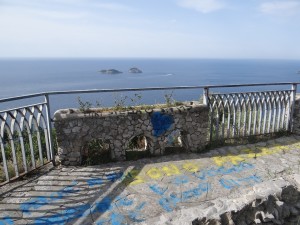

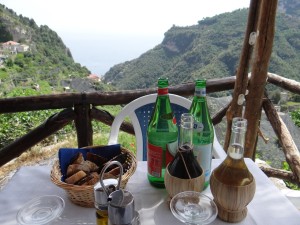
This time, our luxury van felt a bit safer on the twists and turns (I still didn’t see guard rails in some places, just small stone walls) and no one was yelling at the top of their lungs. Although the group found my story pretty funny. We would stop at various lookout locations along the Amalfi Coast to enjoy the beautiful coastline, admire the homes perched along the cliffs and view the water below. It was a day of in and out of the van and we coasted through the many little towns along the way. We would lunch later in the day at the top of a village sitting outside on the balcony enjoying the foods, wine, new friends and serenity of the gorgeous view.
So it seemed fitting that on my sabbatical, I’d revisit the Amalfi Coast, after my visits to Naples, Capri and Sorrento. I started with a bus of senior citizens, then a van full of cruise folks and now I met Marcello to take me back to the viewpoints on my own photo tour of the Amalfi Coast (the Positano fruit stand is still there!).
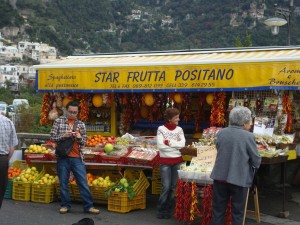
The Views of the Amalfi Coast
The views in over twenty years hadn’t changed much however the cruise ships discovered the coast with a day in the port of Naples. The little villages are now full of white sneakered cruise tourists looking for souvenirs (rarely locally made) and pizza. I think they are missing the best part of the Amalfi Coast – the views and the villages.
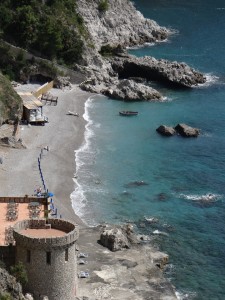
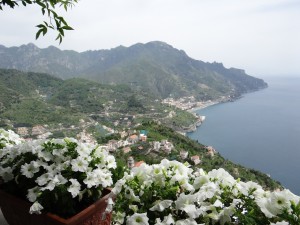
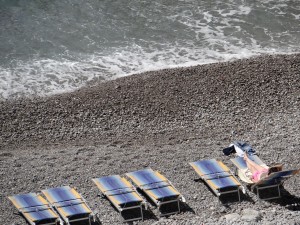
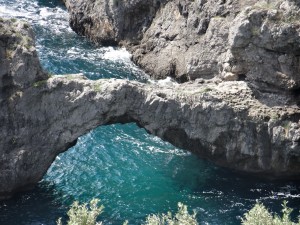
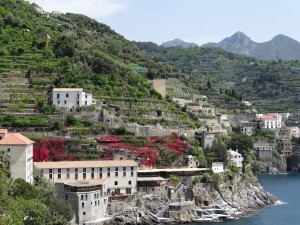
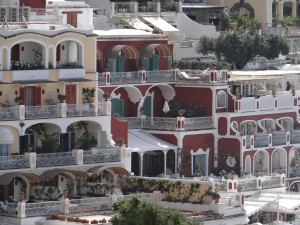
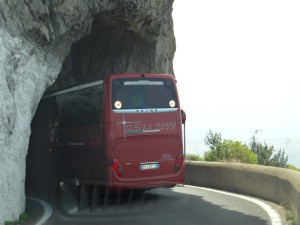
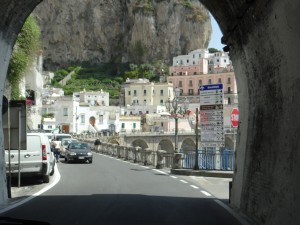
The Amalfi Coast is made up of a collection of villages built into the cliffs both above and below the street level. You will see many steps from the road walking up or down so be prepared to do steps if you find a flat to stay. Once on the two lane road it’s a bit of follow the leader as you are at the mercy of the traffic ahead of you and delays at many tunnels if there is a bus vs. bus situation as only one wins out. If you are on a cruise stop in Naples, do opt for a private guide tour like See Sorrento (with Marcello) to get the best value from your day.
The Five Star Pit Stop along The Amalfi Coast
During the drive, I had one bathroom stop at the fancy five star hotel, Hotel Santa Caterina (which has hosted celebrities, dignitaries and political figures) – I had to pretend to be interested in the hotel to ask for a brochure and then ask where the bathroom was (if only the Italians would just let me use the bathroom instead of the pretense or requirement to buy something). I then asked if I can take a photo or two (lamenting my good camera left in the van). Generally the main part of the hotel is at street level then the rooms, pool and beach are located below. This is the fancy, five star view of the Amalfi Coast.
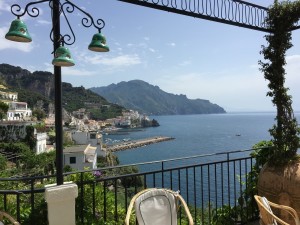
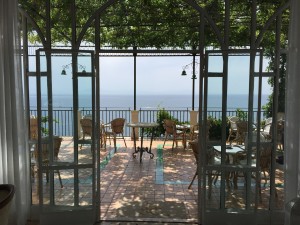
Views Along the Amalfi Drive
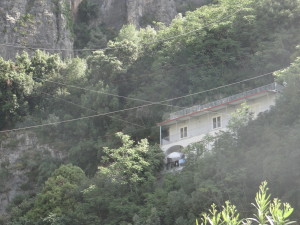
For the rest of the time, we followed the slow traffic on the two lane road that snakes up and down the cliffs and through the village’s practically scraping people and buildings along the way (it’s a tight squeeze in a few places). The road is not for the faint of heart in my opinion and I’m happy I had Marcello to drive it so I could just enjoy being a passenger with my camera. I was on my own photo safari and Marcello was easily able to accommodate my requests to stop for this or that photo. When he saw a place to park along the side of the road (a rarity) he would stop and we would get out to explore the area. I saw the ropes that were in use between villages up on the hills to transfer goods, saw the roadside Nativity displays in the villages and looked down at what seemed like a hidden beach. It was this flexibility to stop and explore that a private guide affords you.
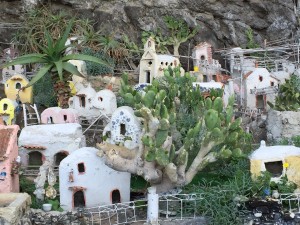
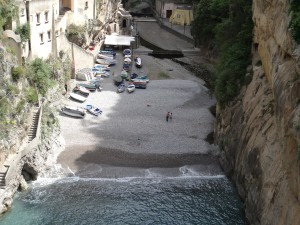
Ravello – Villa Rufolo Amalfi Coast Views
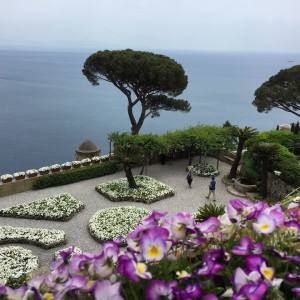
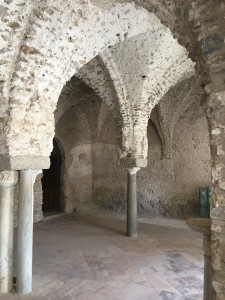
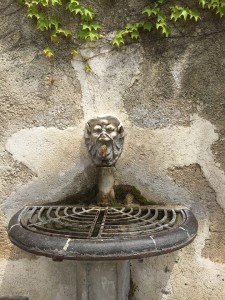
In Ravello, I had an hour to explore and Marcello told me to go to Villa Rufolo, an 11th century villa. The entrance fee was €5.00. Walking through the serene gardens to the villa and then beyond to the Amalfi Coast view was really relaxing. It wasn’t as crowded as the town square was with tourists in the church, at the cafes and sitting around waiting for their pickup to return to the ships. I had time to sit on benches and look at trees and views that many literary folks had done eons before me. Relaxing in beauty and history isn’t the worst way to spend the day.
Amalfi Coast Village Lunch Stop
When I ready to leave, I texted Marcello to pick me up and we explored the villages away from the coast before revisiting that lovely café at the top of the town I had enjoyed years before with my new cruise friends. This time rather than drive to the entrance, we parked like locals at the bottom and walked up through the village. I think Marcello figured I needed a workout pre/post lunch given the many food and drink samples there would be.
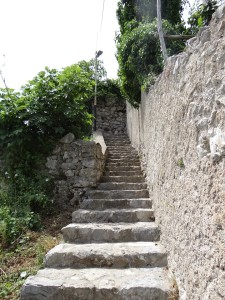
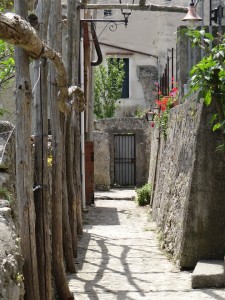
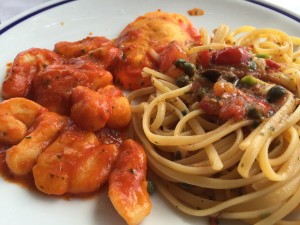
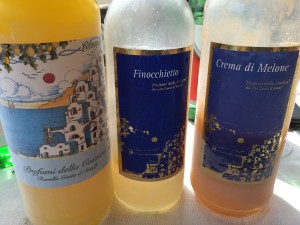
Walking up the steps (there were many steps) we passed homes with lemon trees in their gardens and the smell of flowers growing all around. The small lanes were lined with homes and the stone path continued upward until we reached the restaurant. A bit of a huff and puff was rewarded with a view, some red wine, Italian pasta, bread and desserts.
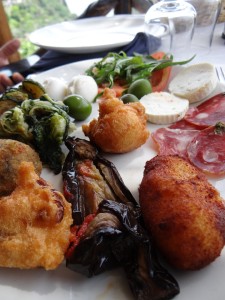
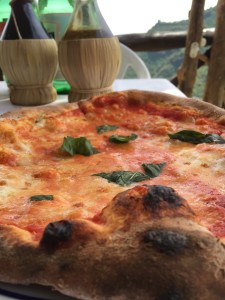


Saying Ciao! (for now) to the Amalfi Coast
Our day on the Amalfi Coast and Amalfi Drive was sadly over as we made our way back through the town going down the stairs back to the road (some towns have thousands of steps from the main road to the top, thankfully this wasn’t one of them). We joined the caravan of cars, vans, busses, and vespas back on the famous two lane road to snake back into Sorrento. It was my last view of the coast that seduced me in my 20’s and continues to call me back with each visit to Italy.